

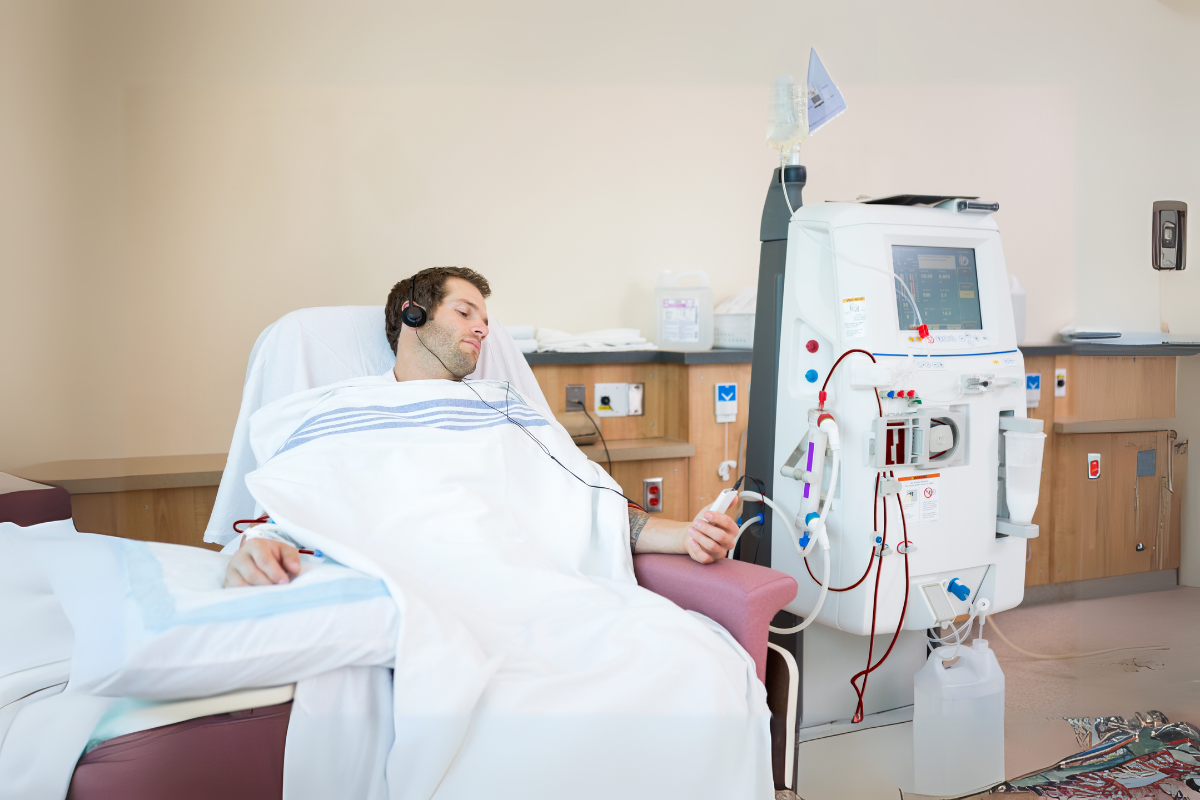
Dialysis is a life-saving treatment used when the kidneys can no longer remove waste, excess fluid, and toxins from the blood effectively. It may be needed in advanced chronic kidney disease (CKD), kidney failure, or certain cases of acute kidney injury. However, not every CKD patient needs dialysis. This article explains what dialysis is, when and why it is needed, how it works, its types, benefits, risks, and common myths.
A Quick Look at Chronic Kidney Disease
Chronic kidney disease (CKD) means the kidneys are damaged and slowly losing their ability to work. This damage happens over months or years, not overnight. Common causes include:
- Diabetes (high blood sugar)
- High blood pressure
- Long-term infections or blockages in the kidneys
- Some inherited kidney conditions
- Overuse of certain medicines over many years
Doctors divide CKD into five stages, from mild (Stage 1) to very severe (Stage 5). Each stage is measured using the GFR number, which shows how much blood the kidneys can clean in a minute. A healthy GFR is around 90 or higher.
Stage | GFR Range | What It Means |
Stage 1 | 90 or above | Kidney damage present, function still normal |
Stage 2 | 60–89 | Mild loss of function |
Stage 3 | 30–59 | Moderate loss of function |
Stage 4 | 15–29 | Severe loss of function |
Stage 5 | Below 15 | Kidney failure, also called end-stage renal disease (ESRD) or end-stage kidney disease |
At Stage 5, the kidneys work at less than 15% of normal. This is usually when doctors start talking seriously about dialysis or a transplant. Reaching Stage 5 does not always mean dialysis must start that same day — some patients are watched closely and start only when symptoms appear.
What Is Dialysis?
Dialysis is a treatment. It does the job that healthy kidneys usually do. When kidney function drops too low, the body cannot clean itself. Waste and extra fluid build up inside. This can make a person very sick. Dialysis steps in to clean the blood and remove extra fluid, just like healthy kidneys would.
There are two main types of dialysis:
- Hemodialysis – A machine cleans the blood outside the body.
- Peritoneal dialysis – A special fluid cleans the blood inside the belly.
Dialysis does not replace every job of the kidney. For example, it does not make the hormone that helps build red blood cells. Because of this, some dialysis patients also need extra medicine or iron to prevent low red blood cell counts, called anemia.
Types of Dialysis
There are three main types of dialysis. Each one is used in different situations.
1. Hemodialysis
Hemodialysis uses a dialysis machine and a filter called a dialyzer. People often call the dialyzer an artificial kidney, because it does the same job as a real kidney.
Here is how the hemodialysis procedure works, step by step:
- Blood leaves the body through a vascular access point.
- A pump gently moves the blood into the dialyzer.
- Inside the dialyzer, thousands of tiny fibers filter out waste, extra salts, and extra fluid.
- Clean blood flows back into the body.
- This cycle repeats again and again during the session, until the blood is fully cleaned.
A vascular access point is needed to move blood in and out safely. There are a few kinds:
- AV fistula – A vein and artery are joined together under the skin, usually in the arm. This is often the safest and most long-lasting option, but it needs some weeks to heal before it can be used.
- AV graft – A small man-made tube joins the vein and artery. This can be used sooner than a fistula.
- Dialysis catheter – A soft tube placed in a large vein, often in the neck or chest. This is usually used for a short time, or in emergencies.
Hemodialysis can happen in different places and at different times:
- In-center hemodialysis – Done at a dialysis clinic, usually three times a week, with trained staff nearby.
- Home hemodialysis – Done at home, after training, giving more freedom and a more flexible schedule.
- Nocturnal hemodialysis – Done at night, often while the patient sleeps, either at home or in a center. Longer, slower sessions can be gentler on the body.
2. Peritoneal Dialysis
Peritoneal dialysis works in a different way. It uses the lining inside the belly, called the peritoneal membrane, as a natural filter. This lining is full of tiny blood vessels, which makes it good at filtering waste.
Here is how the peritoneal dialysis procedure works, step by step:
- A soft catheter is placed into the belly through a small surgery, ahead of time.
- A sterile fluid, called dialysate, flows into the belly through the catheter.
- The fluid stays inside the belly for some hours. During this time, waste and extra fluid move from the blood into the fluid.
- After the waiting time, the used fluid drains out into a bag.
- Fresh fluid is added again, and the cycle repeats.
There are two common forms:
- Continuous Ambulatory Peritoneal Dialysis (CAPD) – Done by hand, several times a day, no machine needed. The patient can walk around and do daily tasks while the fluid is inside.
- Automated Peritoneal Dialysis (APD) – A machine does the fluid exchanges automatically, often overnight while the person sleeps, so the daytime is free.
Peritoneal dialysis can usually be done at home. This gives many patients more freedom in their daily life and less travel to a clinic.
3. Continuous Renal Replacement Therapy (CRRT)
Continuous Renal Replacement Therapy (CRRT) is a slower, gentler type of dialysis. It runs for 24 hours a day, non-stop, instead of a few hours at a time. It is mostly used in hospital intensive care units. It helps very sick patients, especially those with sudden kidney injury, whose blood pressure or heart is too weak to handle regular hemodialysis.
Hemodialysis vs. Peritoneal Dialysis: A Simple Comparison
Feature | Hemodialysis | Peritoneal Dialysis |
Where it’s usually done | Clinic (or home) | Mostly at home |
How often | 3 times a week, few hours each | Daily, shorter exchanges |
Needs a machine? | Yes, dialysis machine | Sometimes (APD), not always (CAPD) |
Access point | AV fistula, graft, or catheter | Belly catheter |
Travel needed | Often, if done in-center | Rarely |
Training needed | Yes, for home hemodialysis | Yes, for home peritoneal dialysis |
There is no single “best” choice for everyone. The right type depends on the patient’s health, lifestyle, home support, and personal choice. A nephrologist helps the patient pick the best fit.
Why Is Dialysis Needed? When Is Dialysis Needed?
Dialysis is usually needed when kidney function drops very low. Doctors often look at a number called the GFR (glomerular filtration rate), which shows how well the kidneys filter blood. When GFR falls below 15, and the patient also has symptoms of kidney failure, dialysis may be recommended.
But here is something important to know: doctors do not decide based on this number alone. They also look closely at symptoms, blood test results, fluid levels, and the person’s overall health.
Signs You Might Need Dialysis
Here are common signs of kidney failure that may point toward needing dialysis:
- Severe or ongoing tiredness and weakness
- Swelling in the legs, ankles, feet, or face
- Nausea or vomiting that does not go away
- Shortness of breath from extra fluid in the body
- Trouble controlling fluid buildup
- Dangerous changes in body salts (electrolyte imbalance)
- A big buildup of waste and toxins in the blood
- Confusion or trouble focusing
- Little or no urine output
If you notice these signs, it’s important to talk to a doctor soon. Waiting too long can be dangerous.
Let’s look closer at two of the most serious signs:
- Electrolyte imbalance – Electrolytes are salts in the blood, like potassium and sodium. They help the heart beat and the nerves work. When kidneys fail, potassium can rise too high. This is dangerous because it can cause an unsafe heartbeat. This is one of the most urgent reasons doctors may start dialysis quickly.
- Waste and toxin buildup – When urea and other wastes build up too much, it is called uremia. Uremia can cause confusion, poor appetite, itching, and a general feeling of being very unwell. Dialysis removes these wastes and often brings quick relief.
Getting Ready for Dialysis
If a doctor recommends dialysis, there is usually time to prepare. This can include:
- Learning about hemodialysis and peritoneal dialysis, and choosing the type that fits best
- Getting an AV fistula placed early, since it needs weeks to heal
- Getting a belly catheter placed early, for peritoneal dialysis
- Learning how to manage diet and fluid intake
- Talking with family about support at home
- Meeting a dietitian, who can guide food choices like limiting salt, potassium, and phosphorus
Starting early, before an emergency, usually leads to a smoother and safer start.
Benefits of Dialysis Treatment
Dialysis can help patients with kidney failure in many ways:
- Removes waste and toxins from the blood
- Removes extra fluid from the body
- Helps keep body salts balanced
- Reduces symptoms like swelling and tiredness
- Helps control problems caused by kidney failure, like high blood pressure
- Supports the patient while waiting for a kidney transplant
- Can extend and improve quality of life for many patients
It’s important to remember: dialysis helps manage kidney failure, but it does not cure the disease and it does not bring the kidneys back to normal.
Dialysis Risks and Side Effects
Like any treatment, dialysis can have some risks. These can be different depending on the type of dialysis used.
Common dialysis risks and side effects include:
- Low blood pressure during hemodialysis
- Muscle cramps
- Feeling tired after a session
- Infection near the access site
- Problems with the dialysis catheter, such as blockage
- Sudden changes in fluid or body salts
- Belly discomfort or infection (called peritonitis) in peritoneal dialysis
- Itchy skin or trouble sleeping, in some long-term patients
If a patient feels pain, fever, or trouble breathing, they should tell their healthcare team right away. Most side effects can be managed well when caught early.
How Often Is Dialysis Needed? How Long Does Dialysis Take?
This depends on the type of dialysis and the patient’s health.
- Hemodialysis is often done a few times a week. Each session usually lasts a few hours.
- Peritoneal dialysis is usually done more often, sometimes every day, and it can be done at home.
- CRRT runs continuously, usually only in a hospital setting.
The nephrologist decides the exact plan for each patient, based on kidney function, symptoms, and test results. This plan can also change over time, as the patient’s health changes.
Living With Dialysis: Diet and Daily Life
Many dialysis patients need to watch their diet closely. This usually means:
- Limiting salt, to help control fluid buildup and blood pressure
- Watching potassium levels, found in foods like bananas and potatoes
- Watching phosphorus levels, found in dairy and some processed foods
- Limiting fluid intake, especially for hemodialysis patients
A kidney dietitian can build a food plan around each patient’s needs. Many patients can still enjoy meals with family, work, travel, and hobbies, with some planning around dialysis schedules.
Emotional Health and Support
Starting dialysis is a big change. It is normal for patients to feel worried, sad, or frustrated at first. Some patients feel a sense of loss, because their daily routine changes a lot.
It can help to:
- Talk openly with family about feelings and needs
- Join a support group with other dialysis patients
- Ask the healthcare team about counseling or social work support
- Set small, realistic goals for daily activities
Many patients say that, with time and support, dialysis becomes part of a normal routine, not the center of every day.
Busting Common Myths About Dialysis
There are many myths about dialysis. Let’s clear them up, one by one.
Myth 1: Is dialysis painful?
Reality: Dialysis is usually not painful. Some people feel a small pinch when the needle goes in for hemodialysis. Some people feel mild bloating during peritoneal dialysis. If pain happens, tell the healthcare team right away.
Myth 2: Dialysis cures kidney disease.
Reality: Dialysis is life-saving, but it is not a cure. It manages the symptoms of kidney failure. It does not bring back normal kidney function.
Myth 3: Dialysis patients cannot live an active life.
Reality: Many dialysis patients live full, active lives. Hemodialysis often needs three sessions a week. Peritoneal dialysis can be done at home, giving more freedom. Many patients still work, travel, and spend time with family.
Myth 4: Dialysis is only for old people.
Reality: Dialysis is used for people of all ages, from children to seniors. It depends on how serious the kidney disease is, not on age.
Myth 5: Is dialysis permanent? Dialysis is always for life.
Reality: Not always. Some patients need dialysis for a short time, such as after a sudden kidney injury. Others need it long-term. Some patients later get a kidney transplant and stop dialysis.
Myth 6: Dialysis patients cannot eat normal food.
Reality: Patients do need to follow some diet guidance, but they can still eat many foods they enjoy, with some limits and planning.
Dialysis and Kidney Transplant
Dialysis helps replace some kidney functions, but it is not the same as having healthy kidneys. A kidney transplant can be a long-term solution for some patients. In a transplant, a healthy kidney from a donor takes over the job of the failed kidneys.
Not every patient can have a transplant. A nephrologist and a transplant team need to check the patient’s health first, including heart health, infection risk, and other conditions. Some patients stay on dialysis while they wait for a matching donor kidney.
There are two main sources for a donor kidney:
- Living donor – Often a family member or close match, who donates one healthy kidney. This can sometimes happen before dialysis is even needed, called a pre-emptive transplant.
- Deceased donor – A kidney from someone who has passed away and chosen to donate their organs. Patients are placed on a waiting list, and wait times can vary a lot.
After a transplant, patients need to take medicine every day to stop their body from rejecting the new kidney. Regular checkups are also needed to watch how the new kidney is working.
When Should You See a Nephrologist?
You should think about seeing a doctor nephrologist if you have:
- Chronic kidney disease
- Kidney function that keeps dropping
- Abnormal kidney test results
- Ongoing swelling
- Severe or worsening tiredness
- Nausea or vomiting that won’t stop
- Shortness of breath
- Big changes in how often you urinate
- High potassium or other salt problems in the blood
A nephrologist will check your kidneys closely. They will decide the best path forward this could be dialysis, medicine, careful kidney care, or a transplant.
How HealthPil Can Help:
At HealthPil, we connect you with nephrologists you can book online consultation who specialize in dialysis treatment. Whether you’re considering dialysis or have been on dialysis for a while, our experts can guide you through the process, manage your treatment, and help you explore other options like kidney transplantation.
Summary
Dialysis is a life-saving treatment used when the kidneys can no longer remove waste, toxins, and excess fluid effectively. It may be needed in advanced CKD or kidney failure, but not every Stage 5 CKD patient needs dialysis immediately; doctors consider kidney function, symptoms, blood tests, fluid levels, and overall health.
The main types are hemodialysis, peritoneal dialysis, and CRRT. Dialysis can control symptoms and support patients while waiting for a kidney transplant, but it does not cure kidney disease or restore normal kidney function.
FAQs :
1. What is dialysis?
Dialysis is a treatment that removes waste and excess fluid from the blood when the kidneys cannot perform these functions effectively.
2. When is dialysis needed?
Dialysis may be recommended when kidney function becomes very low, often when GFR is below 15, especially when symptoms of kidney failure are present. Doctors do not rely on GFR alone.
3. What are the main types of dialysis?
The main types are hemodialysis, peritoneal dialysis, and continuous renal replacement therapy (CRRT).
4. Is dialysis a permanent treatment?
Not always. Some patients need dialysis temporarily, such as after acute kidney injury, while others with long-term kidney failure may require it for a longer period. A kidney transplant may allow some patients to stop dialysis.
5. Can a person live a normal life on dialysis?
Many dialysis patients can continue working, travelling, spending time with family, and maintaining an active life, although diet, fluid intake, and treatment schedules may require adjustments.
References
- Flythe JE, Watnick S. Dialysis for Chronic Kidney Failure: A Review. Available at:
PubMed - Agarwal AK, Haddad NJ, Khabour S. Hemodialysis. StatPearls Publishing. Available at:
NCBI Bookshelf
Disclaimer:
This article is for educational purposes and should not replace professional medical advice. Always consult your healthcare provider for personalised medical recommendations.

Read our editorial policy