

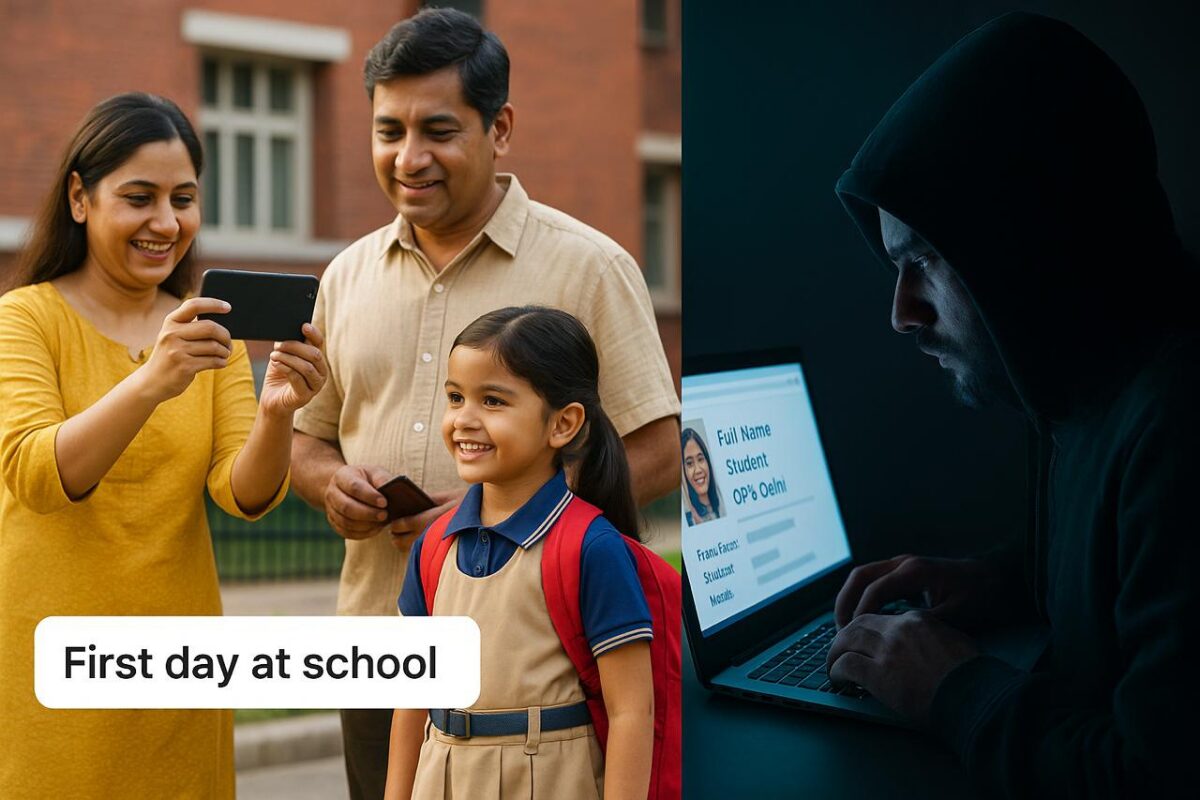
Every parent loves to capture those little moments — the first step, the first day at school, a funny dance, or a random smile. It feels natural to share them online with friends and family. But in today’s world, that one innocent post can travel far and not always to the right places. So, how can something that seems so harmless turn dark in no time?
Most of us think of social media as harmless sharing, but the truth is, anyone can see your child’s photo and not everyone has good intentions. There are online predators and kids are often their target. These predators actively look for such content, and they can easily trace personal information from what we post. A school uniform, a birthday location tag, or even a simple caption like “First day at DPS Delhi” can tell strangers more than you realise; where you live, where your child studies, and what your routine looks like.
When parents post pictures or videos of their children, they make that decision on behalf of someone who cannot yet choose or give consent. Years later, that same child might feel uncomfortable or even angry seeing those old photos online; moments that should have belonged only to them.
Dr. Rahul Chawla, AIIMS trained Neurologist and founder of HealthPil says, “It’s completely normal for parents to share photos or videos of their kids with friends and family. But what many don’t realise is that every post we make leaves behind a digital footprint for our child — one that might stay online forever.
Recently, a young boy who appeared on Kaun Banega Crorepati went viral. Within hours, he was mocked and trolled by thousands of strangers. He probably didn’t even understand why. That’s the harsh reality of the internet, it can celebrate you one minute and destroy you the next.”
Dangers of ‘Sharenting’ and Posting Children’s Photos On Social Media
Today, many children are being turned into social media content. Parents unknowingly push them to dance, act, or say something funny; because it gets likes, shares, and attention. Some children have even become influencers with brand deals, fan pages, and easy money. A few have stopped going to school altogether because their digital life has taken over their real one. Somewhere in this race for content, they lose privacy, peace, and a free, unfiltered childhood, which the 90s kids were fortunate to have.
There’s also an emotional cost that parents don’t always notice. When children grow up constantly being recorded, they start believing that love and attention only come from performance. They pose, smile, and act for the camera instead of living freely. Over time, it can make them anxious or overly self-conscious.
A 2023 study by the University of Michigan found that over 75% of parents share photos or videos of their children online before the age of five, often without understanding the long-term effects. Researchers call this trend “sharenting”, and while it’s oft b kldafb;HXTC en innocent, it can expose children to privacy risks, identity theft, and emotional distress later in life.
Additionally, a French data protection authority (CNIL) report also warned that by the time a child turns 13, nearly 1,300 images of them may already exist online. These photos can form a permanent “digital footprint”, which might resurface years later in schools, jobs, or social spaces; long after the parent has forgotten about the post.
Meanwhile, psychologists have also begun studying the emotional side of this exposure. A 2022 study published in the Journal of Child Psychology and Psychiatry found that children raised in influencer families were more likely to struggle with self-image and boundaries as teenagers. They often felt that their personal moments had been “taken away” and used for content.
Safe Ways to Share and Protect Your Child’s Privacy
The discussion here is not about blaming parents per se, it’s about raising awareness on child safety online. Sharing small moments within close, trusted circles is still fine. Hence, private accounts, family groups, or limited audiences can be safe spaces for connection. The real issue begins with open profiles, viral reels, and oversharing, because once a photo is online, it can be copied, downloaded, or misused and there’s no actual way to take it back.
In today’s age of AI, the risk is even higher. Photos and videos shared online can be scraped into datasets used to train artificial intelligence. Investigations by digital safety researchers have revealed that some AI datasets contain images of minors, including those originally shared on family blogs and social media. AI can now even recreate faces, voices, and even full videos, turning harmless pictures into something completely different.
We believe this is something every parent should think about. Before uploading that latest adorable picture of your child, ask yourself: Are you sharing out of love or for validation from a bunch of strangers on the internet?
FAQs
- Is it safe to post my child’s photo online?
Private sharing with trusted people is fine, but public posts can be misused or tracked digitally. - How can I share photos safely?
Use private accounts, disable location tags, and avoid revealing uniforms or daily routines in captions. - Can I delete old posts later?
Yes, you can, but screenshots and shares may already exist. Once something is public, it can never be completely erased. - Can AI really use my child’s pictures?
Yes, public photos can be scraped and used for AI training or even altered digitally. Always think twice before posting identifiable images of minors.
How HealthPil Can Help
HealthPil helps parents stay informed about child safety, mental health, and digital awareness. Through verified health information and expert-backed insights, we help families make safer choices, both online and offline.
Disclaimer
This article is for educational and awareness purposes only. It does not replace expert advice. Please use discretion and prioritise your child’s privacy whenever you use social media

