

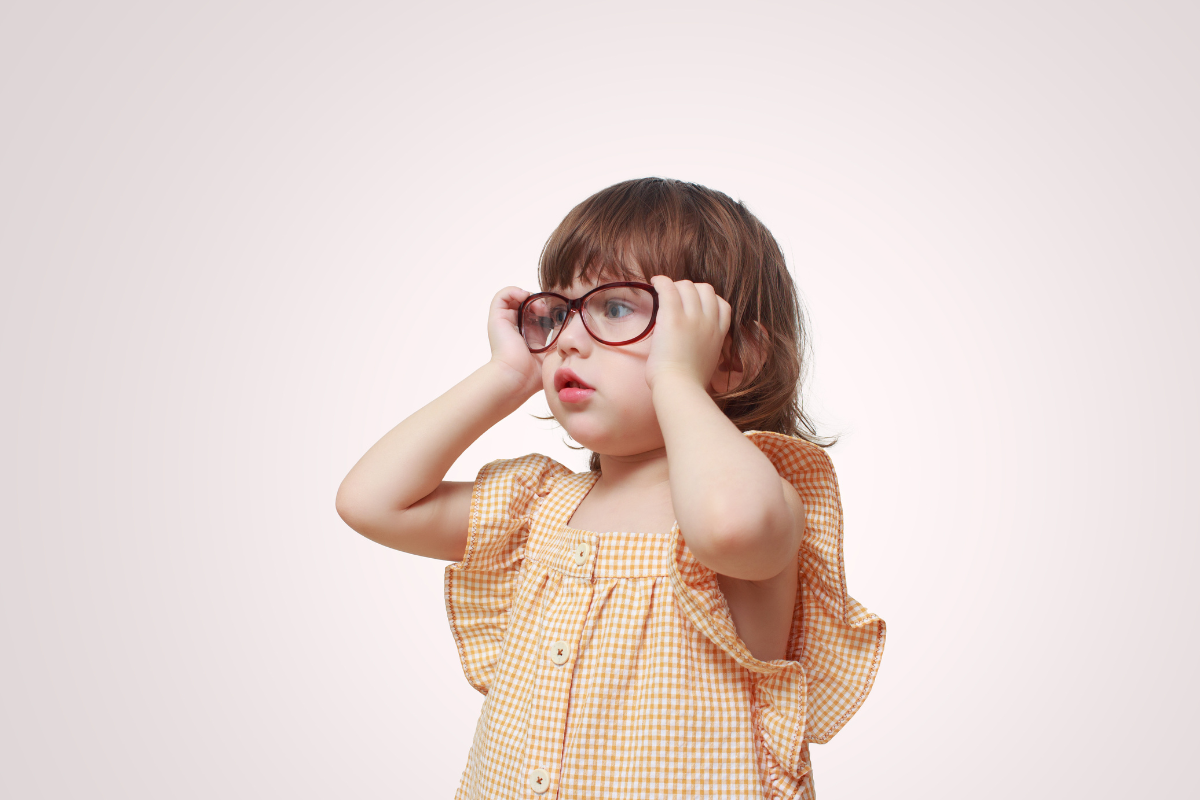
A teacher pulls a parent aside after class. “You should get her eyes checked. She keeps squinting at the board.”
The parent is surprised. Their child never said anything about not being able to see clearly.
This is how most families find out. Not because the child complained, but because the child simply got used to blurry vision without realising that something was wrong.
Take Riya, for example. She loved reading and drawing. But her parents kept noticing she would squint at the TV, struggle to see the classroom board, and hold books unusually close to her face something they had assumed was just a habit. When they finally took her to an eye specialist, the diagnosis was straightforward: childhood myopia. With the right glasses and a few changes at home, things improved quickly. The hard part was that nobody had caught it earlier.
What Is Myopia?
Myopia, or nearsightedness, is one of the most common eye problems in children today. A child with myopia can see things up close perfectly well a book, a phone, a notebook. But anything far away, like a classroom board or a road sign, looks blurry.
Here is what is actually happening inside the eye. In a normal eye, light enters and focuses directly onto the retina at the back. In a myopic eye, the eyeball grows slightly too long, so the light falls just in front of the retina instead of on it. That tiny difference is what makes distant objects look out of focus while close-up vision stays sharp.
Most children do not notice this on their own. They assume everyone sees the world the way they do.
In India, the shift to digital classrooms, online tuitions, and early smartphone use has pushed childhood myopia numbers up sharply over the last decade. Children today are spending more hours on screens and less time outdoors than any previous generation and their eyes are reflecting that change.
Symptoms of Myopia in Children
Children rarely say “I can’t see clearly.” What they do instead is adapt and that adaptation shows up in ways parents can spot if they know what to look for.
- Squinting. Narrowing the eyes to try and see better. This is one of the most common early signs, and one of the easiest to notice.
- Difficulty seeing distant objects. Blurry distance vision, trouble reading the classroom board, struggling to read signs from a normal distance. Teachers often spot this before parents do.
- Eye strain and headaches. Rubbing eyes frequently, complaining of headaches especially after school or long study sessions. The eyes are working harder than they should be to compensate.
- Holding things too close. Books, phones, tablets if your child is consistently holding these very close to their face or sitting unusually close to the TV, that is worth paying attention to.
- Poor sports performance. Struggling to track a ball, misjudging distances, or seeming generally uncoordinated in sports that require sharp distance vision. Parents often attribute this to skill level when the real issue is eyesight.
Causes of Myopia in Children
There is rarely just one cause. Myopia in children usually develops from a combination of factors.
- Screen time. Excessive and uninterrupted screen exposure puts constant close-up demand on developing eyes. Phones, tablets, and computers are all part of this and the smaller the screen and the closer it is held, the more strain it creates.
- Prolonged reading or close work. Hours of near work without breaks is a consistent pattern in children developing myopia. The 20-20-20 rule exists specifically because of this.
- Genetics. If one parent has myopia, the child’s risk goes up. If both parents are myopic, the risk is significantly higher. This does not mean myopia is inevitable, but it means these children need monitoring early.
- Lack of outdoor time. Natural light exposure plays an active role in healthy eye development. Children who spend most of their day indoors, especially under artificial light, have higher rates of myopia development. Two hours of outdoor activity daily is the current evidence-based recommendation — not just for fitness, but specifically for eye health.
Diagnosis of Myopia
Diagnosis is straightforward. An eye specialist will use two main tests.
- Visual acuity test. This checks how clearly your child sees at different distances and determines how significant the nearsightedness is.
- Retinal examination. This looks deeper into the eye to check for any issues beyond the refractive error itself.
Children with a family history of myopia, or those already showing symptoms, should be getting annual eye checks not just when something seems visibly wrong. Myopia caught early gives far more treatment options than myopia caught late.
Treatment Options for Myopia
Glasses
The most common and reliable starting point for almost all children with myopia. Safe, effective, and easy to adjust as the prescription changes.
Contact lenses
Older children and teenagers often prefer these for practical reasons sports, self-consciousness about glasses, better peripheral vision. Require proper hygiene habits, so age and maturity matter here.
Orthokeratology (Ortho-K lenses)
These are rigid lenses worn overnight that gently reshape the cornea while the child sleeps. The result is clear vision during the day without glasses or contacts. They also have a myopia-control effect, meaning they can help slow how quickly the prescription worsens. A good option for children who are active or resistant to wearing glasses during the day.
Low dose atropine eye drops
This treatment does something the others do not it actively slows myopia progression rather than just correcting the current prescription. Usually prescribed for one to two years under close specialist supervision. Increasingly recommended for children whose prescription is increasing rapidly year on year. The dose used is very low, and side effects are minimal at the concentrations prescribed for myopia control.
Myopia control glasses
Specially designed lenses that do two things at once correct current vision and work to slow down how quickly myopia worsens. Different from standard glasses. A specialist will advise whether these are appropriate based on how the child’s prescription is changing.
Laser correction (LASIK)
Not suitable for children or teenagers because the eye is still developing. Some families consider this after age 18 once the prescription has been stable for at least two years. A specialist will confirm if and when it is appropriate it is not a decision to rush.
How to Prevent Myopia in Children
Prevention is most effective before myopia starts, and it is about building consistent habits not one-time fixes.
20-20-20 rule
Every 20 minutes of near work reading, screens, drawing look at something at least 20 feet away for 20 seconds. This gives the focusing muscles of the eye a real break. Simple, free, and genuinely effective when done consistently.
Two hours of outdoor play daily
Natural light exposure is one of the most effective tools for myopia prevention available right now. This is not about physical activity alone it is specifically about the quality of light outdoors and the way it supports healthy eye development. Indoors under artificial lighting simply does not do the same thing.
Limit uninterrupted screen time
Especially small screens held close to the face. It is not just total screen time that matters it is whether the child is taking breaks and how close the screen is.
Maintain proper reading distance
At least 30 to 40 cm between the eyes and any book or screen. This is harder to enforce than it sounds, but it matters over the long term.
Study in good lighting
Dim or harsh lighting forces the eyes to work harder during close-up tasks. Natural light is best. A proper study lamp pointed at the page not at the face makes a real difference. Children studying in poorly lit rooms are putting their eyes under unnecessary strain every single day.
Annual eye checkups
Especially for children with a family history of myopia, or those already showing early signs. Early diagnosis means earlier, more effective treatment.
Complications of Untreated Myopia in Children
Mild myopia that goes uncorrected makes school harder. But that is the least of the concerns when myopia is allowed to progress without management.
Progressive myopia
The prescription increases year on year, sometimes rapidly. Every time a child’s glasses power goes up significantly, it means the eye has grown longer and that change is permanent.
High myopia and its risks
When myopia reaches above -6 diopters, it is no longer just about thicker glasses. The structural changes to the elongated eye create real long-term risks.
Retinal detachment
In a highly myopic eye, the retina is stretched thin and more prone to tearing or detaching from the back of the eye. This is a medical emergency that can cause permanent vision loss if not treated immediately.
Glaucoma
Increased pressure inside the eye that damages the optic nerve over time. More common in people with high myopia than in the general population.
Cataracts
Developing earlier than they would in non-myopic individuals.
Macular degeneration
High myopia can damage the central part of the retina the macula over time, affecting the detailed vision used for reading and recognising faces. A long-term risk that most parents are unaware of.
Academic and social impact
Missing what is written on the board is not just an academic problem. Children who cannot see clearly often fall behind quietly, avoid participating in class, and sometimes get labelled as inattentive when the real issue is simply that they cannot see. Over time, this affects confidence in ways that extend well beyond the classroom.
When Should Parents See a Doctor?
See a paediatric eye specialist if your child is squinting frequently, complaining of headaches, struggling to see the classroom board, rubbing their eyes often, or consistently holding screens and books too close.
Do not wait for the annual checkup if new symptoms appear between visits. A child who was fine six months ago can develop significant myopia quickly especially during growth spurts.
Watch for these red flags specifically:
- Squinting that is getting more frequent, not less
- Headaches appearing regularly after school
- Sitting closer and closer to the TV over time
- Teacher flagging vision concerns
- Sudden drop in sports performance with no injury
If getting to a clinic right away is not possible, an online eye consultation through HealthPil is a practical first step. Describe what you are noticing, and a specialist will advise whether an in-person visit is needed and how soon.
How HealthPil Can Help
HealthPil connects you with experienced paediatric ophthalmologists who can assess your child’s vision, identify how quickly myopia is progressing, and recommend the right treatment whether that is glasses, orthokeratology, low dose atropine eye drops, or myopia control glasses. Whether your child is showing early signs, already has a prescription that keeps changing, or you just want a second opinion on the right approach expert support is available through an online consultation from wherever you are. Book your eye consultation with HealthPil today.
Summary
Myopia in children is becoming increasingly common driven by screen time, reading strain, genetics, and too little time outdoors. Most children do not realise their vision is off. Signs include squinting, headaches, holding things too close, and struggling to see the board at school.
Caught early, myopia is very manageable. Glasses, contact lenses, orthokeratology, atropine eye drops, and myopia control glasses all have a role depending on the child and how fast the prescription is changing. Left unmanaged, high myopia carries real long-term risks retinal detachment, glaucoma, macular degeneration that go far beyond needing stronger glasses.
Two hours outdoors daily, the 20-20-20 rule, proper lighting, and annual eye checkups are the most effective prevention habits available. If your child is showing signs, do not wait. Book an online eye consultation through HealthPil today.
FAQs
Q1. At what age can myopia start in children?
Myopia can begin as early as age 6, but it most commonly develops between ages 8 and 12 and tends to progress through the teenage years while the eye is still growing.
Q2. Can myopia be reversed in children?
Myopia cannot be reversed, but its progression can be slowed significantly with treatments like low dose atropine eye drops, orthokeratology lenses, and myopia control glasses.
Q3. How much outdoor time helps prevent myopia?
Two hours of outdoor activity daily is the current recommendation. Natural light exposure plays a key role in healthy eye development and has been shown to help slow myopia progression in children.
Q4. Are glasses or contact lenses better for children with myopia?
Glasses are the most common and reliable starting point for children with myopia. Contact lenses are an option for older children and teenagers but require proper hygiene habits. A specialist will advise the best option based on the child’s age and prescription.
Q5. What is the 20-20-20 rule for children?
Every 20 minutes of near work such as reading or screen use, look at something at least 20 feet away for 20 seconds. This gives the focusing muscles of the eye a proper break and helps reduce digital eye strain.
Q6. What happens if childhood myopia is left untreated?
Untreated myopia can progress rapidly, leading to high myopia which increases the risk of serious complications including retinal detachment, glaucoma, cataracts, and macular degeneration later in life.
Q6. What happens if childhood myopia is left untreated?
Untreated myopia can progress rapidly, leading to high myopia which increases the risk of serious complications including retinal detachment, glaucoma, cataracts, and macular degeneration later in life.
Q7. Can I get an online consultation for my child's eye problem?
Yes. HealthPil offers online consultations with paediatric ophthalmologists who can assess your child’s symptoms, advise on whether an in-person visit is needed, and guide you on the right next steps.
References
- Subudhi P, et al. Myopia. StatPearls Publishing. Available at:
NCBI Bookshelf - Baird PN, Saw SM, Lanca C, et al. Myopia. Nature Reviews Disease Primers. Available at:
PubMed
Disclaimer:
This information is not intended to replace professional medical advice. Always consult a healthcare provider for diagnosis and treatment options.

Read our editorial policy